
Don't Go to Your Appointment Empty-Handed.
Are your symptoms being overlooked? Many doctors simply haven't been trained on the modern diagnostic protocols for Eagle Syndrome.
Use this document to guide your doctor. It contains the peer-reviewed evidence and imaging requests required to turn a skeptical consultation into a productive diagnosis.

CLINICAL SUPPORT BRIEF: Stylohyoid Complex Pathologies
To: Attending Physician / Otolaryngology / Neurology|Re: Patient Clinical Advocacy
Section 1: Clinical Introduction
Purpose of this Document
This resource has been compiled to assist clinical providers in the differential diagnosis of cervicofacial pain, dysphagia, and neurovascular symptoms associated with the stylohyoid complex. The patient presenting this document reports a persistent history of symptoms consistent with Stylohyoid Complex Syndrome (SHCS).
For a patient-facing overview, see our full guide to the symptoms of Eagle Syndrome.
Current medical consensus is moving away from rigid "Classic" vs. "Vascular" categorizations. Clinical experience demonstrates that patients frequently present with a mixed phenotype, exhibiting simultaneous neuropathic pain and vascular symptoms.
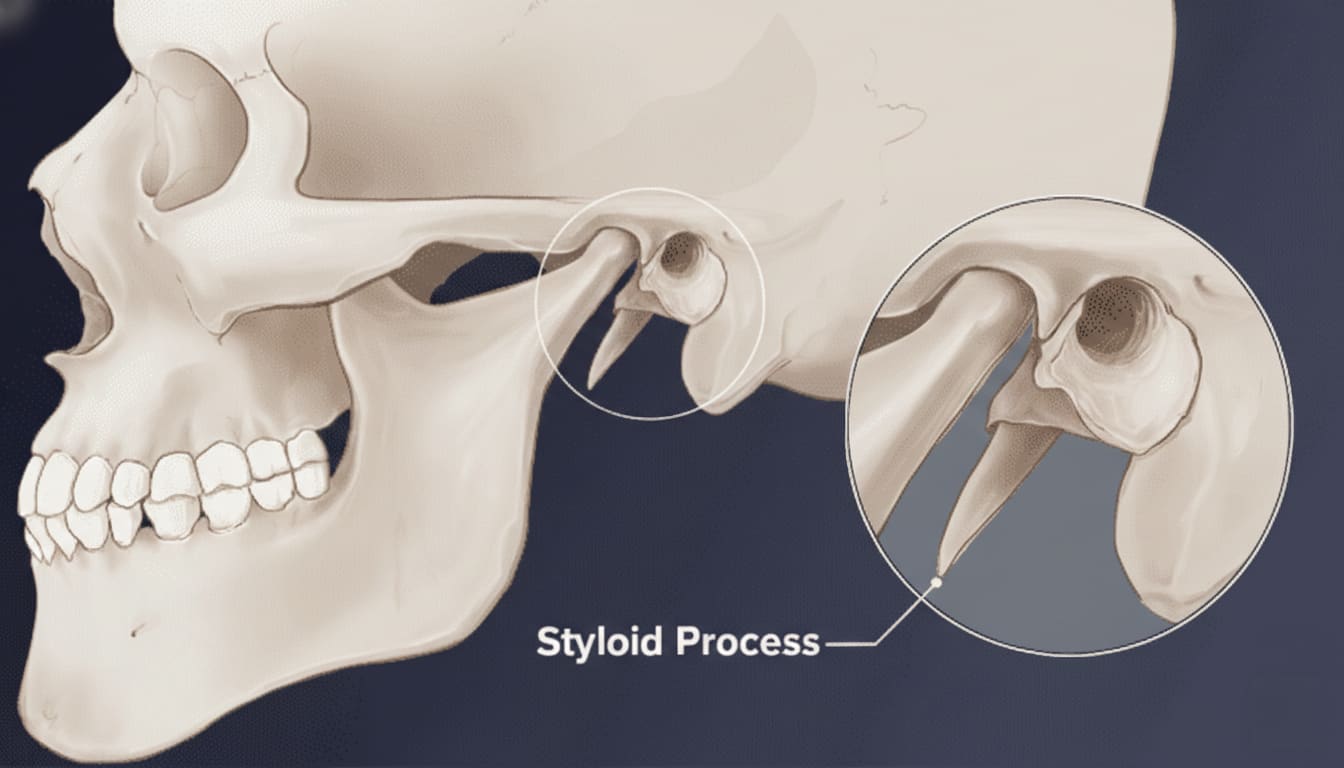
Fig. 1: Stylohyoid Complex Anatomy
Common Clinical Presentations
- Neuropathic:Dysphagia, foreign body sensation, facial pain.
- Vascular:Head pressure, positional headaches, tinnitus, "brain fog."
- Autonomic:Dizziness, tachycardia, anxiety.
Section 2: Updated Diagnostic Protocols
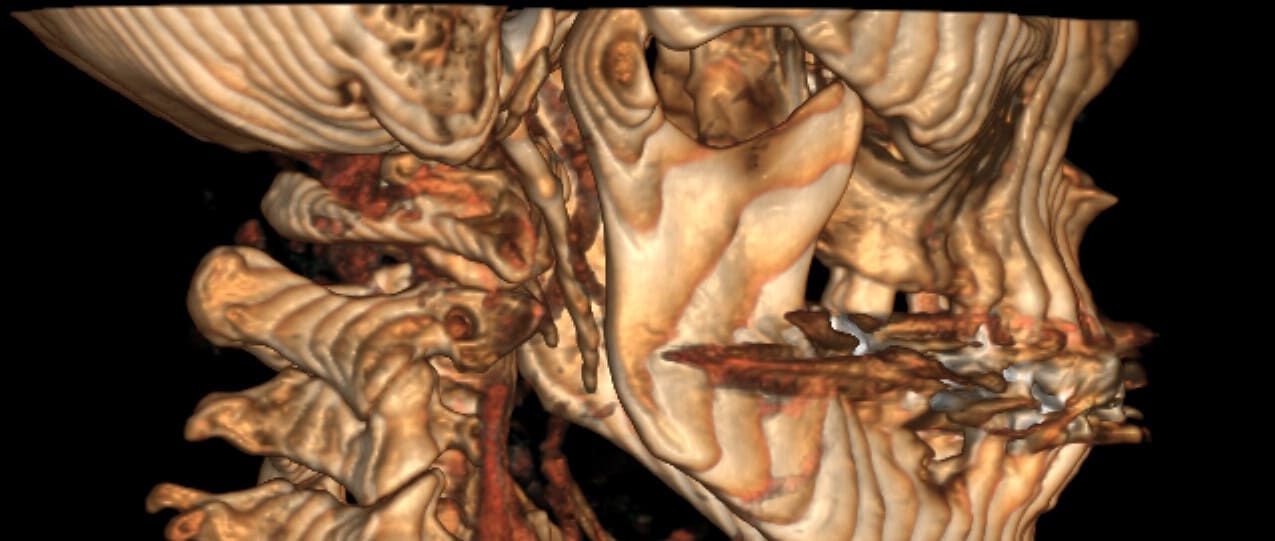
Fig. 2: 3D CT Reconstruction Example
Radiology Request Guidelines
To rule out Stylohyoid Complex Syndrome, specific radiological attention must be paid not just to the bone, but to its relationship with surrounding neurovascular structures.
"Please evaluate the Stylohyoid Complex bilaterally with 3D reconstruction."
Angulation Over Length
Do not limit findings to length (>3cm) alone. Report on medial deviation and angulation of the styloid process.
Styloid-C1 Interval
Measure distance between the styloid process and C1 transverse process (indicator of potential IJV compression).
Vessel Patency
Evaluate for mass effect on the Internal Jugular Vein (IJV) and Internal Carotid Artery (ICA) in neutral position.
Section 3: Peer-Reviewed References
Literature & Evidence
1. The correlation between styloid process length, angle, and Eagle Syndrome based on high-resolution CT.
Frontiers in Medicine, Confirms spatial orientation is more critical than length.
2. Stylo-jugular venous compression syndrome.
American Journal of Case Reports, Establishes "Nutcracker Effect" compression of the IJV.
3. Stylohyoid Complex Syndrome: A new diagnostic classification.
Validates symptom overlap across neuropathic and vascular presentations.

Evidence-Based Medicine